My Salary Is Mine Again | The Money Truth With Adaeze
The Money Truth With Adaeze

Practical Money Systems For Nigerian And African-Diaspora Salary Earners.

Ex-Bank Operations Manager Reveals a Simple 5-Pot System That Helps Nigerian and African-Diaspora Salary Earners Take Control of Their Payday and Stop Running Broke Before Month-End.

Adaeze in a relaxed professional setting

You know that tiny feeling of relief that comes when your salary alert finally enters?

For a few minutes, you breathe differently.

You tell yourself, This month will be different. This time, I will manage it properly.

Then the bills begin.

Rent provision. Electricity. Data. Transport. Food. School fees. A transfer home. One family request you genuinely cannot ignore. Another “small” emergency nobody planned for.

Before you have even done anything enjoyable for yourself, a frightening portion of your salary has disappeared.

By the 10th, you are calculating every purchase. By the 15th, you are opening your banking app with one eye closed.

How did it finish so quickly?

That question hurts even more when your salary is not terrible.

People assume you are doing well. Family members believe you are comfortable. Friends look at your job title and think you have money.

But privately, you know the truth: one unexpected expense could push you back into borrowing.

You work hard, earn what should be a respectable salary and still feel financially unsafe.

And every month you promise yourself that you will save whatever remains—only to discover that nothing ever remains.

Drop what you are doing. Read every word of what I am about to share with you.

Because what I am about to share with you is the same simple system that completely changed everything for me.

My name is Adaeze.

First thing I want you to know—I am not a financial advisor. I am not an accountant.

I am just a salary earner who suffered through this exact problem for years before I finally found what actually works.

And strangely enough, the answer did not come from a budgeting app, an expensive finance course or another complicated percentage rule. It came from a quiet conversation with my 68-year-old aunty in Enugu.

Adaeze working at her desk with a laptop and notebook

For Years, I Earned a “Good Salary” and Still Had Nothing to Show for It

I grew up in Enugu, but I now live and work in Lagos as an operations manager.

For years, I earned ₦480,000 every month. It was the kind of salary that made people nod approvingly when they heard where I worked.

From the outside, I looked financially responsible.

I dressed neatly. I paid my bills. I supported my family. I did not spend every weekend at expensive restaurants, and I was not buying designer bags.

Yet every month followed the same exhausting pattern.

Payday would arrive, and I would immediately start settling everything that had been waiting for me.

I would set something aside for annual rent, send money home, clear my electricity and internet bills, buy groceries, fuel my car and pay for the little expenses that keep an adult life moving.

Then someone would call with a request.

Sometimes it was genuinely urgent. Sometimes it was an expense that could have been planned earlier but had somehow become my emergency.

I would send the money because I loved my family and did not want to appear selfish.

By the end of the first week, I would still have money in my account, so I assumed I was fine.

I would buy lunch at work, renew a subscription, order one or two things online and tell myself I deserved a little comfort after working so hard.

By the third week, my balance would become uncomfortable.

That was when the calculations started.

If I buy fuel today, can I still afford data next week?

Can I delay this payment until my next salary?

Who can I borrow from without sounding irresponsible?

I remember one particular Tuesday when my fuel warning light came on as I was driving home from work.

My salary was still more than a week away.

I parked outside my apartment, opened my banking app and stared at the balance.

There was not enough to comfortably handle fuel, food and data until payday.

I sat in the car for several minutes, feeling ashamed.

Not because I was unemployed. Not because I had experienced a major disaster. But because I earned ₦480,000 and still needed to borrow money for ordinary life.

That night, I asked myself a question I had been avoiding:

“Why do I earn a good salary but still have no savings, no breathing room and no real sense of safety?”

I decided the answer must be discipline.

So I tried to become more disciplined.

First, I used the 50/30/20 rule.

It sounded logical: divide income between needs, wants and savings. But my life did not fit neatly into those percentages.

Where was I supposed to put annual rent? What about family support? What about repairs, weddings, church commitments and the expenses that were not monthly but were still completely real?

The percentages looked beautiful on paper and collapsed the moment real Nigerian life entered the room.

Next, I downloaded budgeting and expense-tracking apps.

For a few days, I recorded everything. Transport. Lunch. Data. Groceries. Transfers.

But I noticed something important: I was recording the money after it had already gone.

The app was giving me a neat history of my mistakes. It was not helping me decide what my money needed to do before I spent it.

Then I tried saving whatever remained at the end of the month.

Nothing remained.

I opened a separate savings account, but whenever an irregular expense appeared, I transferred the money back.

I tried automatic savings. It clashed with unpredictable bills and left me short in my main account.

I attempted no-spend challenges. They made me feel deprived, and the moment the challenge ended, I returned to my old habits.

I watched free budgeting videos online. Most of the advice was generic and seemed designed for people whose biggest concern was reducing coffee purchases.

My reality included annual rent, extended-family obligations, rising prices and responsibilities that crossed households.

I was not failing because I bought too much coffee.

I was failing because my salary entered one account as one large, hopeful figure—and every obligation attacked it from the same place.

The turning point came during a family meeting in Enugu.

I had travelled home for a short visit. One evening, after everyone had eaten, I found myself complaining about money to my aunty, Mama Ngozi.

Mama Ngozi was 68.

She had managed her household on a civil servant’s salary for more than 30 years. She was never flashy, but she always seemed prepared.

When school fees arrived, she had a plan. When something needed repairing, she did not panic. When family members asked for help, she knew what she could give without creating a crisis for herself.

I told her I did not understand how she did it.

I explained that I earned more than she ever had, yet I was constantly anxious.

She listened quietly and asked me one question:

“When your salary enters, what exactly is each part of the money supposed to do?”

I started listing my bills.

She shook her head.

Then she pulled me aside and said:

“Nwa m, the problem is not how much you earn. The problem is you let your money disappear before you give it a job.”

That sentence stayed with me.

She took out an old notebook and showed me how she planned her household money.

She did not use rigid percentages.

She first wrote down what was actually coming in. Then she listed every compulsory payment by deadline and consequence.

After that, she included the expenses most people call unexpected—even though they happen every year.

Rent. Repairs. School costs. Festive travel. Medical checkups. Family commitments.

She converted those large future expenses into smaller monthly provisions.

Finally, she divided the remaining money according to purpose, so the amount available for daily life was separate from money meant for future obligations.

It was almost embarrassingly simple.

But it was also completely different from what I had been doing.

I had been treating the balance in my account as money I could spend.

In reality, most of that balance already belonged to future bills.

When I returned to Lagos, I sat at my dining table with a notebook, my bank statements and a calculator.

I began by recording my true take-home income and the small leaks I usually ignored.

Next, I ordered every bill by its deadline and the consequence of missing it.

Then I uncovered the annual and irregular expenses quietly waiting ahead.

I converted each one into a monthly amount.

Finally, I transferred my salary into five purpose-based pots:

Must-Pay. The non-negotiable bills and responsibilities that kept my life stable.

Live-On. Food, transport, data and the ordinary costs of moving through the month.

Family and Remittance. The amount I could sustainably provide without stealing from rent or my future.

Future and Irregular. Monthly provisions for the large expenses that always seemed to arrive suddenly.

Flex. Guilt-free personal spending within a clear limit.

I did not force my life into fixed percentages. I used my actual numbers.

Within 30 minutes, something changed.

My income had not increased. No debt had magically disappeared. But for the first time, I could see the truth.

I knew which expenses were safe, which ones needed to be reduced and which future bills had to be funded gradually.

By the end of the first 48 hours, every naira had a written purpose.

I knew exactly what was safe to spend.

That knowledge felt like someone had turned on a light in a room where I had been stumbling for years.

The first month was not perfect.

I spent too much during one week and briefly felt the familiar temptation to abandon the whole plan.

Instead, I reviewed my pots for ten minutes, reduced the next week’s flex amount and continued.

That small reset mattered because it taught me that one imperfect week did not have to destroy an entire month.

By the third week, I noticed something unusual.

I was not afraid to open my banking app.

The number inside my account no longer confused me because I knew what each part of it was for.

I stopped borrowing for fuel and data.

I stopped taking money from rent provision to solve ordinary problems.

When family requests arrived, I checked the Family and Remittance pot instead of reacting from guilt.

If there was enough, I gave confidently.

If there was not, I explained what I could do and when I could do it.

At the end of that month, I still had money.

Not imaginary money that belonged to a coming bill. Not an overdraft disguised as breathing room.

Money that was actually mine to carry forward.

My husband looked at me one evening and said:

“Babe, this month is different. You’re not stressed, and you didn’t ask me for money. What did you do?”

I laughed because the difference was so visible that he had noticed it without me saying anything.

The real change was not only in my account.

It was in my mind.

Payday no longer felt like a brief rescue followed by a slow financial emergency.

I began to feel like the owner of my salary instead of a temporary caretaker watching everyone else claim it.

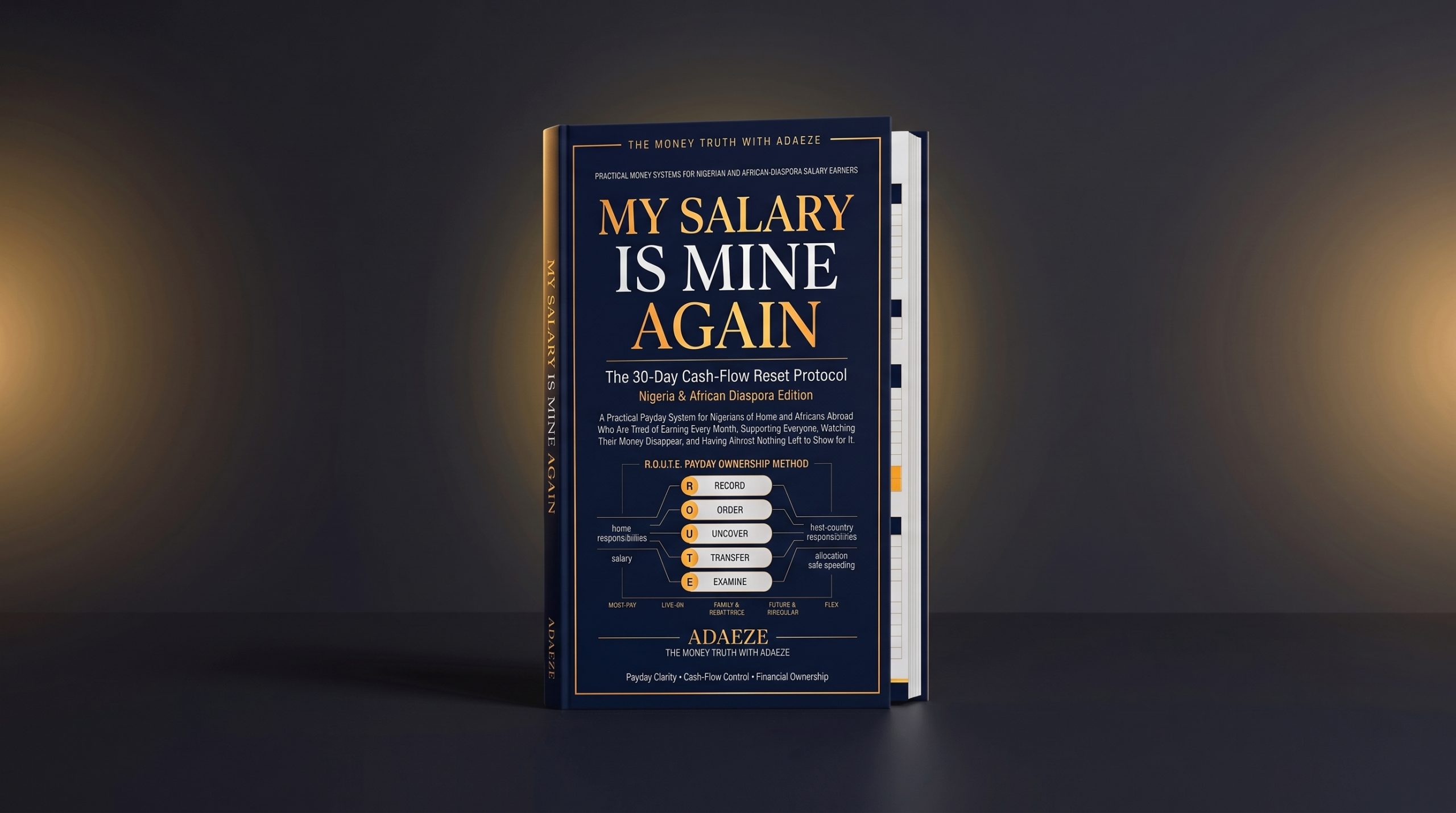
I called the process the R.O.U.T.E. Payday Ownership Method because it gave every part of my salary a route before the month began.

RRecord your real take-home income and money leaks.
OOrder your bills by deadline and consequence.
UUncover annual and irregular costs before they hit.
TTransfer your payday into five purpose-based pots.
EExamine and reset every week for ten minutes.

I shared the method with a colleague who constantly borrowed before payday.

After her first salary cycle, she told me she had finished the month without asking anyone for help.

Then I helped a cousin living abroad who earned in dollars but still felt squeezed between local bills and family responsibilities back home.

He finally created a separate remittance plan instead of treating every request as an unpredictable emergency.

Another friend used the annual-expense calculation and realised that the school fees she called “unexpected” had arrived at the same time every year.

Once she divided the total across the months ahead, the expense stopped feeling like an ambush.

That was when I realised this was bigger than my personal notebook.

The same quiet problem was affecting salary earners in Lagos, Abuja, Accra, London, Toronto, Houston and everywhere responsibilities stretched across two households or two countries.

People were not always careless.

Many simply had no system designed for the life they were actually living.

I Started Getting Too Many Messages to Keep Explaining It One Person at a Time

People wanted the exact worksheets I used.

They wanted to know how I calculated annual rent, how I set up the five pots, what I said when family requests fell outside my plan and how I recovered after overspending.

So I put the full R.O.U.T.E. system inside one simple guide.

Introducing...

The complete 30-day implementation guide

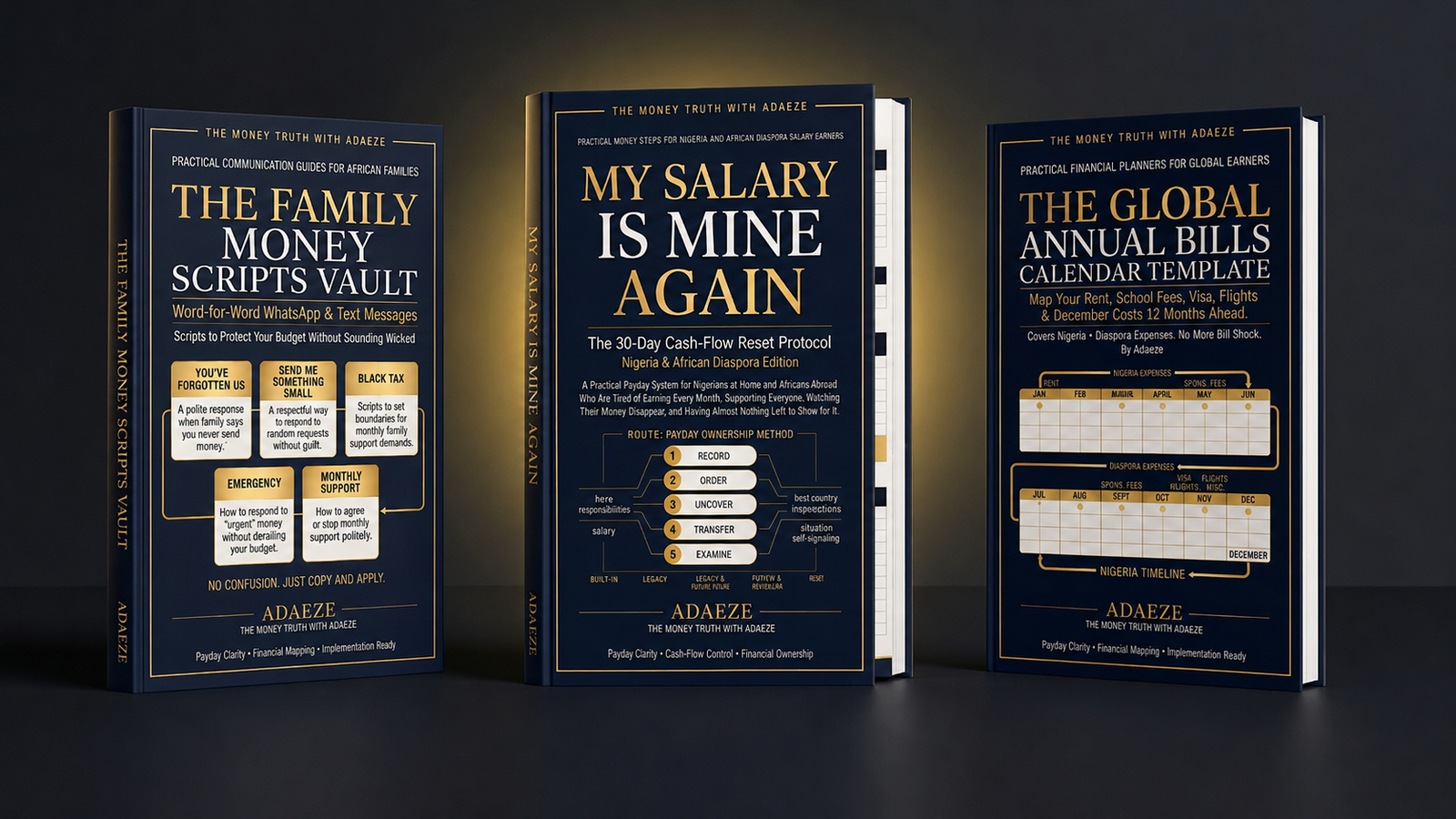
My Salary Is Mine Again

The 30-Day Cash-Flow Reset Protocol

This is not a motivational book you read once and forget.

It is a practical, fill-in-the-numbers system that helps you plan one complete salary cycle using your real income, real obligations and real life.

My Salary Is Mine Again digital guide and family resource mockup

Here Is Exactly What Is Waiting for You Inside:

  • The Payday Reality Snapshot

    See how much of your income is already committed before you spend another naira, pound or dollar.

  • The True Monthly Cost Calculator

    Convert annual rent, repairs, school fees, travel, visa costs and family responsibilities into manageable monthly provisions.

  • The R.O.U.T.E. Payday Planning Sheet

    Give every part of your salary a job on payday instead of discovering where it went later.

  • The Five-Pot Allocation Worksheet

    Organize Must-Pay, Live-On, Family and Remittance, Future and Irregular, and Flex spending using your actual figures.

  • The Irregular Expense Provision Worksheet

    Prepare for the bills that feel unexpected but happen every year.

  • The Family Support Limit Planner and Request Decision Framework

    Decide what you can sustainably provide and respond respectfully when a request is outside your plan.

  • The Safe-to-Spend Calculator and Weekly Reset

    Know your genuine weekly spending limit and correct problems in ten minutes.

  • The Overspending Recovery Card and Next-Payday Checklist

    Recover after an imperfect week without abandoning the entire system.

And the best part?

You do not need perfect discipline. You do not need to earn more. You do not need to use 50/30/20.

It is the same simple method that worked for me—and has since quietly worked for over 30 Nigerian and African-diaspora salary earners I have personally shared it with.

What Other Nigerian and African-Diaspora Salary Earners Are Saying

KA
Kemi A. — Lagos, Nigeria 🇳🇬 3 days ago · ★★★★★
“Chai Adaeze this 5-pot thing saved me. I used the ₦500k example in The Salary Map Pack bonus, and for the first time I had 120k left on the 22nd. No borrowing this month!”
DO
David O. — Houston, TX, USA 🇺🇸 1 week ago · ★★★★★
“I’m earning $4,200 and still felt broke. The Salary Map Pack and Family Money Scripts Vault bonuses helped me plan black tax without guilt. Game changer.”
GE
Grace E. — Toronto, ON, Canada 🇨🇦 5 days ago · ★★★★★
“The Global Annual Bills Calendar Template bonus is everything. I mapped visa, flights and December. No more panic. By Day 2 I knew my safe-to-spend.”
TJ
Tunde J. — Abuja, Nigeria 🇳🇬 2 weeks ago · ★★★★★
“50/30/20 never worked with annual rent. R.O.U.T.E. accounts for everything. 10-minute weekly reset keeps me on track.”
BT
Blessing T. — Calgary, AB, Canada 🇨🇦 10 days ago · ★★★★★
“I sent the WhatsApp scripts from the Family Money Scripts Vault bonus to my group chat. We all dey use am now 😂 No more ‘you’ve forgotten us’ stress.”
EN
Emeka N. — Port Harcourt, Nigeria 🇳🇬 1 week ago · ★★★★★
“Best money I spent this year. The Recovery Card helped me bounce back after I overspent. I feel in control again.”

Leave Your Comment

Thank you. Your comment has been received for review.

Before I Tell You the Price... Let Me Be Honest About What It Cost Me to Create This

I did not throw a few ideas into a document and call it a guide.

I wanted this to be a complete implementation system—something you could open on payday, follow step by step and use without needing another course.

This guide cost me over ₦350,000 / $230 USD / ₵2,800 GHS to put together properly.

  • Researching the cash-flow problems affecting Nigerian and African-diaspora salary earners.
  • Testing the system with beta salary earners across different income levels.
  • Building practical worksheets, calculators, checklists and scripts.
  • Professional editing and proofreading.
  • Professional design and digital-product formatting.
  • Website, payment and instant-delivery setup.

I could reasonably charge the full creation cost for private help.

₦350,000
₦180,000
₦90,000
₦45,000
₦15,000 / $9.97 / ₵120

One payment. Instant digital access.

This discounted price is only available for the first 30 people who pay today. Once those 30 spots are gone, the price returns to ₦45,000 / $29.97 USD / ₵360 GHS.

Do not close this page and come back later expecting to pay the same amount.
Yes — Send Me My Salary Is Mine Again Right Now! Secure payment. Instant digital delivery after payment.

Wait—I Am Not Done Yet

If you are among the first 30 people, you also get everything below:

My Salary Is Mine Again main product mockup

Main Product: My Salary Is Mine Again

Value: ₦45,000

The complete 30-Day Cash-Flow Reset Protocol with eight core worksheets, calculators and planning tools you need to take control of your payday.

The Salary Map Pack bonus mockup

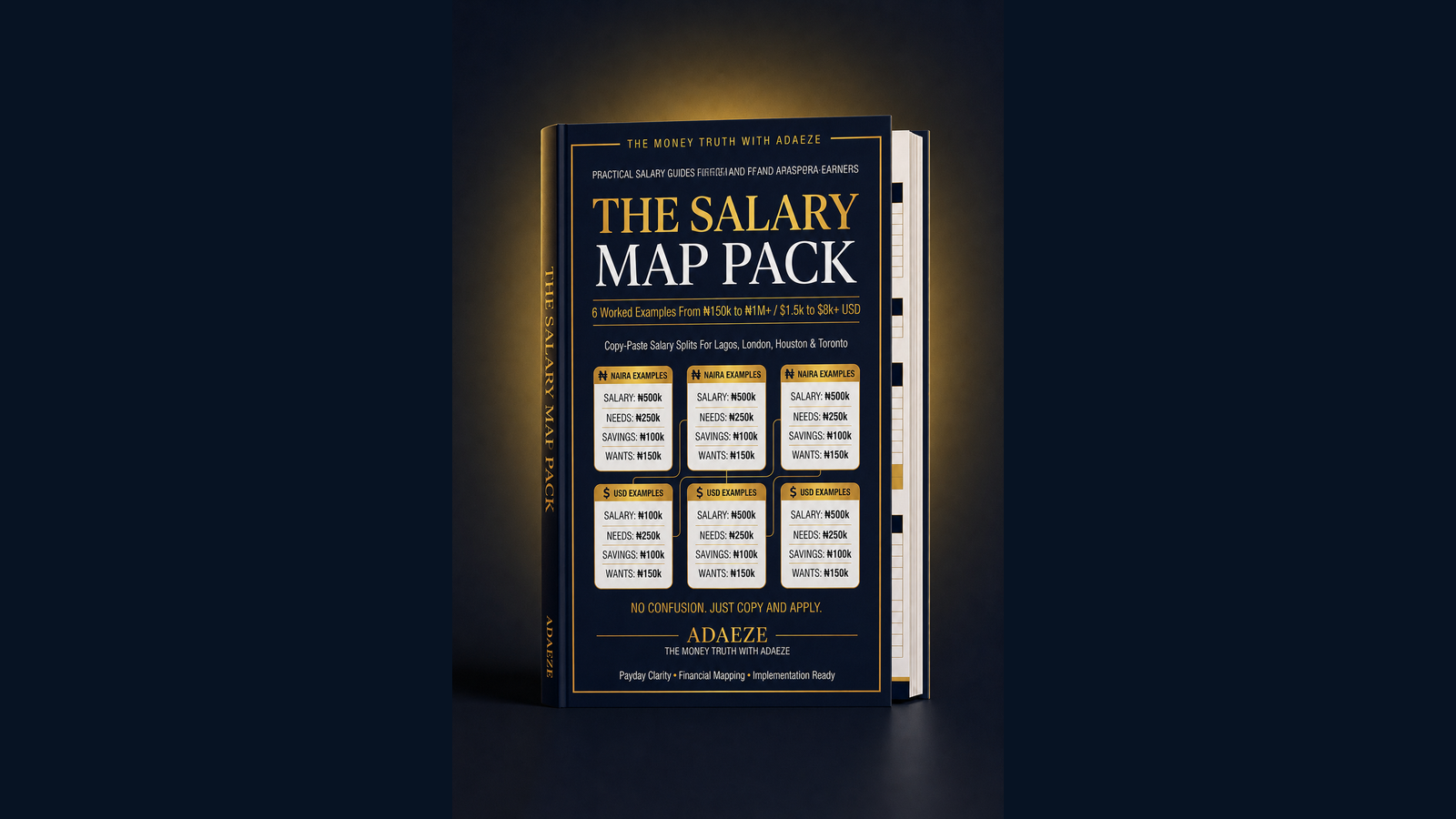
Bonus 1: The Salary Map Pack

Value: ₦25,000

6 Worked Examples From ₦150k to ₦1M+ / $1.5k to $8k+ USD.

This stops the "but how do I apply this to my salary?" confusion by showing you exact splits you can copy today.

It includes three naira examples and three diaspora examples covering dollar and pound salaries, so whether you earn in Lagos, London, Houston or Toronto, you can see yourself in the plan.

The Family Money Scripts Vault bonus mockup

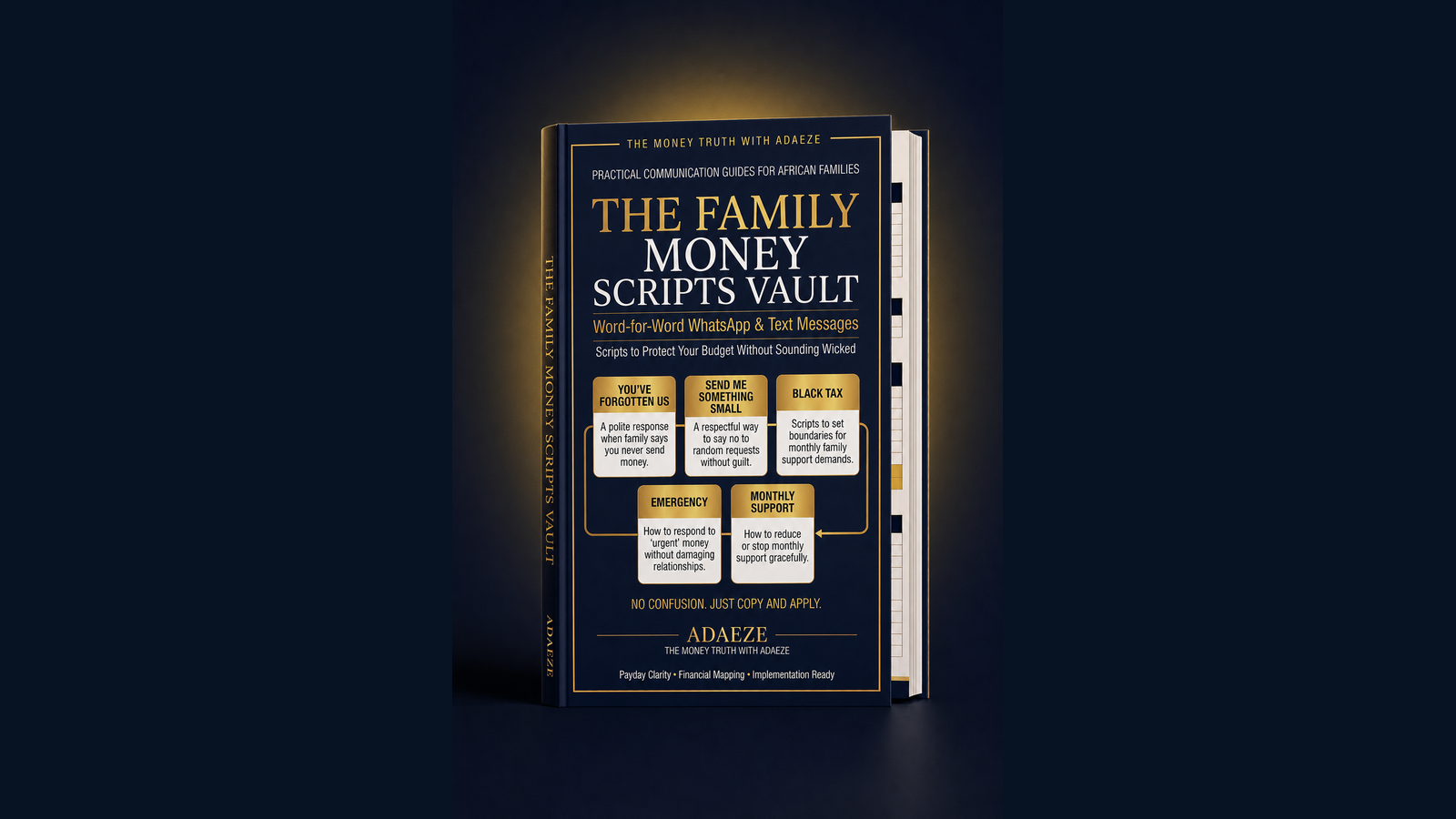
Bonus 2: The Family Money Scripts Vault

Value: ₦15,000

Word-for-word WhatsApp and text messages.

You get the exact words to respond to guilt trips like "you've forgotten us" or "send me something small" without sounding wicked.

These scripts help you protect your budget and your relationships, so you can support people sustainably without sacrificing your own compulsory expenses and future goals.

The Global Annual Bills Calendar Template bonus mockup

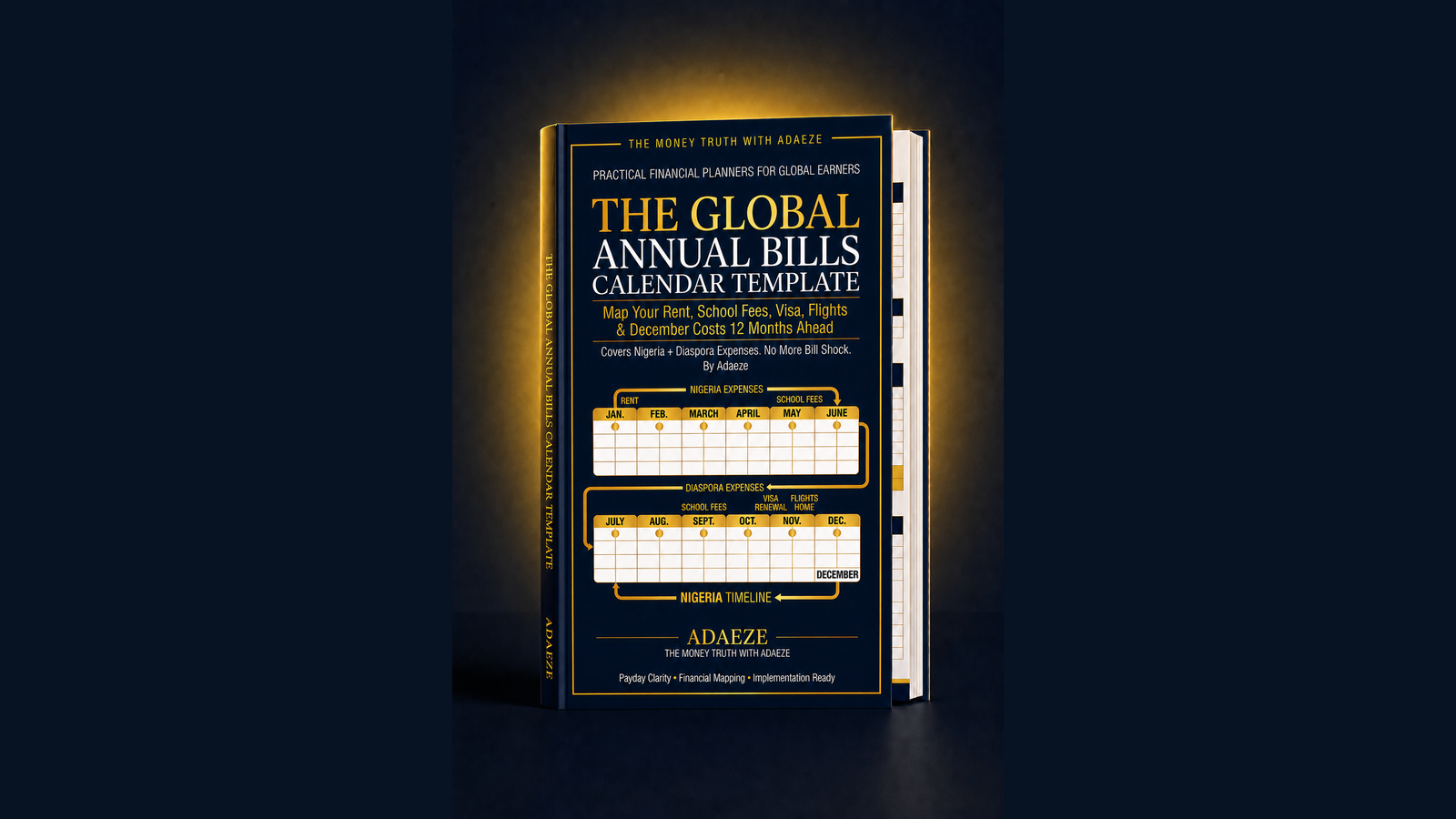
Bonus 3: The Global Annual Bills Calendar Template

Value: ₦35,000

This ends the shock of "big bills" by helping you map rent, school fees, visa renewals, flights and festive costs twelve months ahead.

It shows you what to provide each month so the money is already waiting when the bill arrives.

It covers both Nigerian and diaspora expenses, helping you prepare for immigration fees, trips home, December commitments and other predictable obligations.

Complete My Salary Is Mine Again product and bonus bundle
The total value of everything is ₦120,000.
You are getting all of it today for just ₦15,000.
Get My Salary Is Mine Again + All Bonuses Right Now — ₦15,000 Secure checkout. Your digital guide and bonuses will be delivered after payment.

People Are Already Taking Control of Their Next Payday

My Salary Is Mine Again Buyers • 47 Members Tap a message to pause the feed
09:14 AM Kemi Lagos PAID: Just paid! Can't wait to start 💃
09:17 AM David Houston PAID: Done! Payment complete from Texas
09:22 AM Grace Toronto PAID: Money sent from Canada 🇨🇦
09:28 AM Tunde Abuja PAID: I have been waiting for this
09:35 AM Blessing Calgary PAID: Paid! Thank you Adaeze
09:41 AM Emeka PH PAID: Just paid. Instant delivery please
09:47 AM Aisha London PAID: Done from UK. Can't wait
09:53 AM Chinedu NY PAID: Payment complete from New York
10:02 AM Ngozi Benin PAID: Just paid!
10:08 AM Adaeze: Thank you all! Check your email for delivery. Only 5 spots at this price.

Only 5 spots left at this price.

You are not the only person looking at this page right now.

Secure Your Copy Before the Price Returns to ₦45,000 Instant digital access after successful payment.
100% Money Back 30 Day Guarantee

The 30-Day Try-It-Properly Guarantee

Use the system for 30 days. Complete the exercises and apply it to one salary cycle.

If you don't get clarity and control over your money, email me and I'll refund 100% of what you paid.

No questions asked.

Start My 30-Day Cash-Flow Reset — ₦15,000 Your purchase is protected by the 30-Day Try-Guarantee

Real Questions From Salary Earners Like You

CL
Chioma L. — Lagos, Nigeria 🇳🇬 2 days ago

Q: Is this another generic budgeting ebook?

Adaeze replies: No. This is not theory. You’re getting an implementation system—worksheets, calculators, payday pots, remittance planning and a full 30-day action process. You’ll know exactly what to do on payday.

MK
Michael K. — London, UK 🇬🇧 5 days ago

Q: Is this another Western budgeting system?

Adaeze replies: No. It accounts for annual rent, family support, black tax, church and community commitments, remittances, immigration expenses, currency conversion and the reality of supporting responsibilities across two countries.

TS
Tolu S. — Abuja, Nigeria 🇳🇬 1 week ago

Q: I’ve tried budgeting before—why is this different?

Adaeze replies: Most budgeting systems track spending after it has happened or force you into fixed percentages. R.O.U.T.E. helps you make decisions before spending begins. So you’re in control on Day 1.

GA
Grace A. — Toronto, Canada 🇨🇦 3 days ago

Q: What if people depend on me?

Adaeze replies: This doesn’t tell you to abandon your family. It helps you determine what you can sustainably provide without sacrificing compulsory expenses and your own future stability. The ready-to-send scripts are supplied separately in the Family Money Scripts Vault bonus.

DO
David O. — Houston, TX, USA 🇺🇸 6 days ago

Q: I earn in dollars. Do I still need this?

Adaeze replies: A stronger currency doesn’t guarantee financial security when you have high local costs, relocation expenses, remittances and responsibilities in two countries. The dollar and pound salary maps are supplied separately in The Salary Map Pack bonus included with the complete bundle.

EJ
Emeka J. — Enugu, Nigeria 🇳🇬 1 week ago

Q: Will it work with a tight salary?

Adaeze replies: The system cannot create additional income. But it will reveal whether your numbers balance and help you identify what must be reduced, delayed, renegotiated or funded gradually. Clarity first.

NP
Ngozi P. — Accra, Ghana 🇬🇭 4 days ago

Q: Is this a get-rich-quick product?

Adaeze replies: No. It does not promise wealth in 30 days. It promises a practical process for understanding, planning and controlling one complete salary cycle. That’s how peace starts.

What Other Nigerian and African-Diaspora Salary Earners Are Saying

NO
Ngozi O. — Benin City, Nigeria 🇳🇬 4 days ago · ★★★★★
“I finished 30 days without borrowing. The Recovery Card saved me when I overspent.”
MJ
Michael J. — Atlanta, GA, USA 🇺🇸 1 week ago · ★★★★★
“The $6,500 example in The Salary Map Pack bonus was exactly me. I finally budget for naira black tax AND dollar bills.”
SW
Sarah W. — Vancouver, BC, Canada 🇨🇦 3 days ago · ★★★★★
“The Family Money Scripts Vault bonus is gold. I can say no now without damaging relationships.”
PU
Peter U. — Uyo, Nigeria 🇳🇬 2 weeks ago · ★★★★★
“₦700k earner here. Even at my level I was broke. This showed me why.”
AM
Aisha M. — Ottawa, ON, Canada 🇨🇦 5 days ago · ★★★★★
“My husband and I do the weekly reset together. No more money fights.”
SA
Samuel A. — Lagos, Nigeria 🇳🇬 1 week ago · ★★★★★
“Annual rent no longer catches me. The Global Annual Bills Calendar Template bonus had me ready 6 months ahead.”

You Have Two Choices From Here

PATH 1

You take action today.

You follow R.O.U.T.E. using your real income and obligations.

Within 48 hours, you have a written plan and know what is safe to spend.

By Day 30, you can finish your salary cycle with greater clarity, stronger control and money assigned to the future before it disappears.

PATH 2

You close this page.

You return to the same payday routine and keep hoping that next month will somehow be different.

You continue borrowing, moving money between accounts and wondering where your salary went.

And somewhere in the back of your mind, you keep wondering whether this simple system would have worked for you.

Your salary works too hard to keep disappearing without a plan.

You do not need another month of financial confusion to prove that the current approach is not working.

You need a route for your money—a system that recognises your bills, your family, your future and your real responsibilities.

It is time to make your salary yours again.

Get My Salary Is Mine Again + All Bonuses — Only ₦15,000 (5 Spots Left) Secure payment. Instant digital delivery. 30-day guarantee included.

This page is for informational and educational purposes only. This is not personalised financial, investment, tax or legal advice. Results may vary according to income, expenses, circumstances and implementation.

© 2026 The Money Truth With Adaeze. All rights reserved.

Contact: nachioge@gmail.com